


Ever wonder why Walmart is so successful? “It’s because they never stop,” enthuses an industry observer: When it comes to the lottery category, “They never stop paying attention to the business, learning about the business and, when something works, they know how to scale it up.”
Operators and supplier-partners across the 34 states where the retailer currently offers lottery can attest to its drive: focus on the fundamentals, innovate within the category, strive to execute tightly, and always maintain the consumer as the primary focus.
It’s not surprising that in recent years the retailer has seen the greatest movement up the rankings among the top 20 national chains that offer lottery. In the decade-plus journey since its first lottery pilot, the Walmart team has influenced and improved upon dozens of ways lottery functions relative to the business routines and sales environment of a large corporate chain—benefitting lotteries and the good causes they serve, as well as the industry overall.
“The way Walmart looks at the category is a bit different than how others view it. In how they use data to automate different aspects of the business to improve execution, reduce labor hours, and increase overall performance – they’re an industry-changer,” says Gina Easley, IGT Senior Manager National Retail Accounts, who plays a pivotal role in translating the retailer’s goals and leading practices across 21 IGT-customer jurisdictions. Among many responsibilities, Easley is part of a dedicated group at IGT that has forged a strong relationship with the Walmart team and been a catalyst for its efforts to advance the industry in collaboration with U.S. lottery partners. This IGT group took the lead early on in working with the retailer and lottery customers to establish its category standard for sales-data reporting—now a requirement for any jurisdiction deploying the category with Walmart. The standard is the foundation of the retailer’s auto-reconciliation program, which will help to minimize the labor hours needed to reconcile the lottery program at the store level and improve operational efficiencies. In addition, monthly consolidated reports derived from IGT’s Retail Market Insights™ (RMI) database provide Walmart with the cross-jurisdictional sales data to gauge its program performance and help identify best practices for expansion.
From the beginning, Walmart knew vending would help drive execution and installed lower-profile lottery vending machines (LVMs) appropriate to the retailer’s environment. Understanding that visibility of the lottery program in stores was critical, the Walmart team suggested alternate dimensions and configurations for lighted jackpot signs to be placed on the top of LVMs to increase lottery program awareness within their Supercenter locations—resulting in positive increases in the number of customer plays.
More “classics” of lottery execution that the Walmart team has advanced with its lottery-industry partners include:
 Ambassador Programs: In the vast space of a Walmart Supercenter, it is critical to raise consumers’ awareness that lottery is available. Walmart has embraced both initial rollout and recurring Ambassador programs that allow lottery personnel to directly engage with both consumers and—maybe more importantly—Walmart associates. “Building awareness and partnering with associates at the store is critical to the long-term success of the program,” notes Easley.
- Reducing Out-of-Stocks (OOS) and Increasing New Game Activations/Deployments: Each of the Walmart divisional managers works with the states on weekly updates, which are communicated to the stores and market managers. Sales reps continue to work with the stores to improve OOS and the activation of new games within the first 72 hours of launch. The retailer is always looking for further ways to improve, such as automating this process with real-time alerts at the store level.
- LVM Optimization: Two key drivers of optimizing LVM sales are proper placement and, where warranted, multiple machines. Walmart continually evaluates the placement of LVMs to maximize consumer visibility and accessibility as its retail space constantly evolves with new front-end transformation projects. Walmart is receptive to working with lotteries to deploy multiple LVMs where warranted and relocate equipment based on consumer traffic flow and suggestions from the lottery, after completing store surveys. In addition, the Walmart team will consider placing full-size LVMs on the front wall of the stores, in addition to the low-profile machines at their self-checkout kiosks, depending on store layout and space availability. New York, for example, has deployed 80% of the Supercenters with two or more LVMs, with some stores having three machines, and has been able to drive material increases in sales in these locations.
- Go Where the Customers Are:
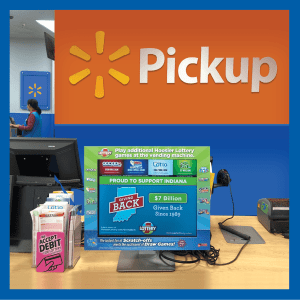 Historically, shoppers were unaware that they could purchase and redeem lottery in the tobacco checkout lane that was equipped with a lottery terminal at each store where Walmart placed LVMs. The Walmart Lottery team pivoted and partnered with each state to relocate the terminal to the Customer Service area, where there is additional space for classic lottery merchandising, such as ESMM digital signage, and check-a-ticket. All new states deploy the terminal at Customer Service, which has had a positive impact on the visibility of the program and improved the ramp-up rate within the states. “What’s admirable about the Walmart team is their willingness to pilot and test against their historical limitations. If we can prove the results and it’s not disrupting their business, they will advocate to expand the practice,” says Paul Riley, IGT Vice President Retail Innovation and Partnerships.
- Increase Facings: Walmart continues to review opportunities for expansion and to improve same-store sales, recently agreeing to pilot a limited number of instant-ticket facings in their Neighborhood Market formats in Indiana. Walmart plans to further expand the pilot to a few additional states, exemplifying their willingness to experiment and drive sales.
- Increase Uptime: Retailers across the U.S. continue to face staffing issues with limited associates, high turnover, and heavy workloads, affecting both lottery training and equipment maintenance. Walmart looked for a more automated method of troubleshooting issues and initiating a service call to minimize down equipment and increase overall LVM performance. The solution, developed by IGT, is a scannable QR Code on each terminal, allowing associates to troubleshoot common issues on a linked Service Ticket portal, and, if the issue isn’t resolved, click on the chat icon and be connected to a live agent or, if necessary, schedule a service call. Having successfully rolled out in Indiana, the retailer hopes to expand this automated Service Ticket portal.
- Training: In California, the Supercenter program launched with additional access to training tutorials, giving associates the ability to link to quick training videos on loading games, loading printer paper, and other common needs by scanning QR codes placed conveniently inside the door of Walmart LVMs, where they are performing the processes. Since deployment, the California Supercenter program has continued to exceed expectations. In addition, Walmart will be kicking off additional training programs within existing states. This will give associates the opportunity to attend classroom training to help improve operational execution.
“Our learning is never finished,” says Anne Johnson, Director Walmart Everyday Services. “We’re always excited to hear what’s next and how/if we can bring that to life in Walmart.”
