

Recent Job Listings

If you’re one of the billions using Google Chrome, you know it tracks what you do online. Small files, dubbed cookies, record everything from purchases, searches, time spent, interests, and again, everything. Advertisers use them to sell goods they think you will like. In January 2024, Google began piloting the removal of cookies from the most popular browser, ostensibly over privacy reasons. As an individual, you may appreciate an increased sense of privacy. As a marketer, it could pose challenges for your future campaigns.
What Is A Cookie?
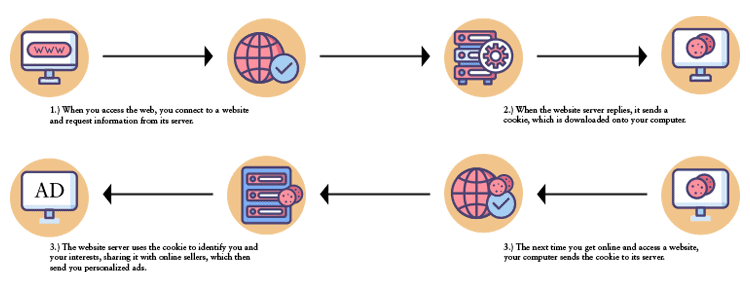
When surfing the web, sites store data packets on users’ browsers. Their purposes vary, from remembering usernames and language preferences to tracking the websites you visit. They help websites and their advertisers identify who you are. They come in two flavors, but only one is considered harmless.

First-party cookies are created by the website you are on. They work within the confines of the visited website, and their purpose is primarily to facilitate a smoother, more personalized web experience, like remembering what you put into your shopping cart. From a privacy standpoint, these are benign.
In contrast, third-party cookies (“cookies”) are installed by domains other than the one being visited. They construct detailed profiles of users’ browsing habits for user behavior analysis, which helps personalize advertising.
A Heated Debate
Cookies’ intrusive nature has sparked ethical concerns, leading to significant scrutiny. This scrutiny resulted in regulatory responses. One provision in the European Union’s General Data Protection Regulation (GDPR) forces websites to obtain consent from users before installing them.
These responses spooked major tech companies. In 2018 and 2019, Apple’s Safari and Mozilla’s Firefox browsers began limiting third-party cookies. The last refuge for cookies, and arguably the most important, was Chrome, which accounts for 65% of internet traffic worldwide, making it three times as popular as Safari. But in January, Google began the eviction process. It announced Chrome was restricting cookies for 1% of Chrome users for the initial rollout. It also plans to roll out these changes to Android, its mobile operating system. The removal of cookies is part of a broader project called “Privacy Sandbox.”
Another critical component of Privacy Sandbox is Google’s replacement for cookies, a new technology called Topics. Like cookies, Topics tracks users’ histories. Depending on the sites you visit, Topic groups users into 300 predefined “topics” based on their browser history. When a user visits a site with the Topic API, it selects three topics to share with the site and its advertising partners. Since these groups are so large, it becomes impossible to track an individual, guaranteeing privacy. Topics are also only stored on the device, without involving external servers, including Google’s servers.
Other advertising companies are upset. While the use of cookies in online tracking has raised privacy concerns among the public, these tools have been pivotal in reducing advertising costs through their targeted capabilities. Cookies help the tracking of users across various internet platforms and devices, serving as the backbone of advertising analytics. The diminishing presence of cookies in the digital landscape, prompted by privacy concerns and regulatory changes, has significantly complicated the landscape of digital advertising. This was underscored by a 2022 study from Criteo, which found that “Topics,” the proposed cookie replacement, was five times less effective.
Bill Simmons, Vice President of Product at the Trade Desk, a demand-side platform (DSP) many lotteries use, expresses his concerns about the industry’s future in a blog. (A DSP is a type of software that enables advertisers to buy advertising efficiently, using programmatic advertising for real-time transactions.) Simmons highlights the limitations of the Privacy Sandbox initiative: “Privacy Sandbox likely has very few winners outside of Google, if any,” he says. “Not only will ads in the Privacy Sandbox command a lower CPM, but the technological complexity involved in their activation is also extremely high. Additionally, becoming dependent on these Topics APIs could leave companies at Google’s mercy in the long term.”
Simmons’ concerns reflect a broader apprehension within the digital advertising community, which regulators have tried to address. The United Kingdom’s Competition and Markets Authority (CMA), tasked with preventing anti-competitive activities and protecting consumer interests, raised concerns in 2020 about the potential anti-competition issues stemming from the phasing out of cookies. In 2022, the CMA accepted legally binding commitments from Google to address these competition concerns, with Google agreeing to apply these commitments globally.
Despite these developments, Simmons remains skeptical about the ultimate objectives of Google’s sincerity, writing: “In my opinion, the objective of the whole project could be boiled down to improving the privacy positioning of the Chrome browser by deprecating third-party cookies and any associated and similar features, but also making sure that open internet advertising doesn’t reach the moon and instead is just open enough to avoid the attention of antitrust authorities,” he wrote.
What Are Lotteries Baking Up?
With Safari and Firefox switching over in 2019, the lottery industry has had plenty of time to adjust to the changing ecosystem. “We haven’t seen a large impact yet, but we expect to see some changes here very soon,” Jessie Teague, Director, Strategic Marketing, Kentucky Lottery Corp., says.
Lotteries have protected themselves by better using their first-party data. “Advertising agencies more heavily rely on first-party data and investing in multi-faceting media modeling. Additionally, they use an independent media-buying platform that enables cross-device and cross-channel strategies without cookies,” Rhonda Fehr, Advertising Manager, Missouri Lottery, said.
DSPs use this data with identity graphs (ID graphs). An ID graph is a database that takes all identifiers a lottery might have collected—anything from emails, phone numbers, loyalty club usernames, etc.—and connects them back to a single player. This unified profile is called the “single view” or “golden record.”
The Kentucky Lottery uses The Trade Desk for most of its programmatic spending. The Trade Desk’s proprietary ID graph, Unified ID 2.0, is independent of third-party cookies and supports advertisers’ need to run personalized ads targeted to specific consumers without compromising their privacy. “We utilize our first-party data through our CRM. We take various segments of our Fun Club members… and serve ads to those lists of people,” Teague says. “Then we use lookalike modeling to expand those lists.”
The Illinois Lottery and Allwyn North America use a Data Management Platform (DMP) that collects, manages, and uses data for improved targeting. A DMP collects data ranges like demographics, locations, behaviors, etc., to form audience segments. “It allows us to leverage our first-party data (e.g. registered players) whenever possible,” Nicole Schaefer, Media Manager, Allwyn North America, says. “Via media partner dentsu’s Merkury product suite, we’re also able to tap into people-based, cookie-less data to build custom audiences at scale and execute across a breadth of media platforms and publishers.”
The integration of first-party data with social media platforms has been effective. “We use our first-party data in Meta through Optimove. It has been incredibly valuable to us,” Teague adds. “It has a direct integration with Facebook, so it’s more efficient and responsive and we don’t have to manage it constantly.” The Illinois Lottery also tests second-party data, which is when two companies share first-party data. “We’re testing second-party providers like InMarket and 7-Eleven, to reach high-value prospects that may not yet be part of the iLottery ecosystem,” Schaefer says.
Agencies have also begun prioritizing probabilistic data sets—information assumed based on the users’ behaviors—over deterministic data—information known to be true. “Agencies are increasingly moving to programmatic marketplaces to access more contextual data and predictive audiences (or cognitive data), which are probabilistic data sets that are already widely available,” Barbara Jones-Frederick, Senior Advertising Manager, Maryland Lottery, explains.
The Maryland Lottery has been partnering with vendors who use endemic ads instead of programmatic ones. While programmatic ads rarely have anything to do with the site they appear on, endemic advertising ensures that the ad and the website’s content are aligned, meaning they have a thematic connection. For instance, a game with a prize trip to Hawaii might be advertised on a travel blog to Hawaii. This approach opens the door to finding new partnerships.
Other lotteries have done the same. “Over the years, we’ve shifted targeting away from cookies and more into contextual targeting and utilizing first-party data segments… While the death of the cookie makes tracking a user across the internet more challenging, it forces digital marketers to think more strategically, which is never bad,” Olivia Merklinger, Two Tango, Virginia Lottery Account Executive, says.
Left With Crumbs
With such meticulous preparation, the deprecation of cookies may not affect the lottery industry at all. However, it is essential to return to Simmons’ comments. Delving into Simmons’ insights sheds a different light. His article speculates that, in the best-case scenario, Google appears as the only victor. He argues that advertising costs might skyrocket, becoming less efficient and more time-consuming.
“Many of us in the lottery industry have already dealt with the loss of cookies. The concern for me is what the data implications will be,” Shad Barnes, Senior Manager, Digital Marketing, Oregon Lottery, comments. “How will it affect segmentation and targeting? What happens with the competition amongst DSPs and digital advertisers? Less is not more in that world.”
Everyone should find it more challenging to access the same level of third-party data before the loss of cookies. However, ads bought on Google and shown on Google websites still have the same granular user data. The millions engaging daily with Google services, from Search to YouTube, Gmail, and Fitbit, contribute to a comprehensive user profile.
Google and the other tech giants can provide significantly deeper insights than their smaller competitors, which will be left with crumbs. How can these smaller platforms keep up when they’ve lost so much data? Barnes warns lottery marketers they need to be more vigilant.
“All these folks that have been selling you on the idea that they have rich data… they may not be as trustworthy. You have to do your due diligence.”
It may seem that Google will become the preferred advertising platform. But for lotteries, there’s an added layer of complexity. Google’s inconsistent history with lottery product advertisements adds a layer of uncertainty. “Dealing with Google is a constant negotiation about whether they support our product ads. Their growing dominance is worrisome. We need to ensure we have alternatives,” a concerned marketer, preferring anonymity, expressed.
Underdone
Cookies’ demise prompts a closer look at the intricate interplay between technology, advertising, and social responsibility. It may be a win for privacy. It also may leave the digital advertising marketplace significantly less competitive. Lotteries must understand how their loss could impact them now and in the future. Otherwise, their future marketing campaigns may feel a little underdone.