

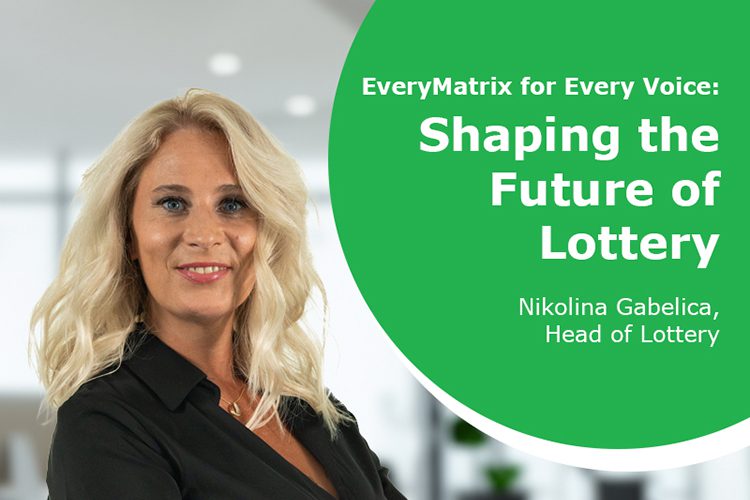
By Nikolina Gabelica, Head of Lottery at EveryMatrix
As the lottery and iLottery sectors rapidly evolve—driven by digitization, shifting player expectations, and rising demands for integrity—one crucial conversation remains underexplored: the role of women and broader diversity in shaping the sector’s future.
According to recent WLA and EL reports, 57.2% of employees across reporting WLA Regular Members are women, yet only 31% hold top-level management roles and 34% board member positions in EL member lotteries.
While this reflects a persistent gender gap in leadership, regional observations reveal encouraging momentum in some parts of the world. Europe and North America show comparatively higher representation of women in executive roles, including several female-led lotteries. Female leadership, however, remains rare across Latin America, Africa, and Asia-Pacific, underscoring the need for sustained global efforts beyond isolated progress.
Women have long held leadership roles in public lotteries. Increasingly, they are also at the helm of major private lottery groups, shaping strategy and innovation at the highest level.
Pioneers such as: Rebecca Paul, the first female WLA President and founder of the Women’s Initiative in Lottery Leadership (WiLL) programme; Romana Girandon, the first woman to lead both Loterija Slovenije and the European Lotteries; Charmaine Mabuza, the first female and first Black woman CEO in Africa’s gaming sector; and Esmeralda Britton González, the first woman to chair Costa Rica’s national lottery and the first Latin American woman elected to the WLA Executive Committee, have led with vision and measurable impact.
Stéphane Pallez, Sue van der Merwe, Sigrid van Aken, Tonje Sagstuen, and Andria Vidler, among others, continue to show that strong female leadership is not an exception but a growing norm.
Yet, when we shift our focus to lottery suppliers and technology vendors, especially in product design and platform development, female representation declines significantly. Among major lottery suppliers, the representation of female CEOs currently stands at zero, clearly demonstrating the need for industry-wide reflection and intentional action to address this imbalance. While public lotteries are often in the spotlight, the platforms and digital systems that power them, built by suppliers, also need to reflect the diversity of those they serve.
Equality Is Not a Competition
Men and women aren’t competitors, we are collaborators. What drives our industry forward is shared commitment, integrity, and the freedom to bring one’s full self to the table. Recognizing when balance is missing isn’t a criticism; it’s an opportunity. True diversity includes gender, ethnicity, age, and culture, and when embraced, it builds stronger teams, richer ideas, and a more resilient culture.
A Personal Milestone
At the end of last year, I was honoured to join the WiLL programme in Europe as a mentor. For the first time, suppliers were invited to participate. This recent expansion highlights ongoing progress and momentum. As Romana Girandon, President of EL, said in support of the programme, “WiLL continues to grow, creating a path for talented and passionate women to realize their full potential in the lottery sector.”
Through WILL, I’ve connected with inspiring mentors and mentees from across the lottery world. Their diverse perspectives reinforce how much value is unlocked when we foster inclusion. One of them is my mentee, Anna Herczeg, Head of Brands and Campaigns at Szerencsejáték Zrt.
Although she is new to the lottery sector, her fresh perspective, professionalism, and enthusiasm make working with her truly enjoyable. I look forward to seeing how she shapes the future of our industry. It’s worth mentioning that one participant from Veikkaus is a man, showing that while the programme supports women in leadership, it also values male allies advancing inclusivity.
Leading by Example
One lottery that exemplifies leadership on multiple levels is Norsk Tipping. With CEO Tonje Sagstuen at the helm, they are on a bold mission to be 100% digital in three years. Their focus on sustainability, player protection, and responsible growth makes them one of the most progressive lotteries in the world. I’m proud that EveryMatrix is one of their trusted partners.
At Norsk Tipping, gender balance is not just a tick box exercise. Their 2024 sustainability report reveals a management team that is 43% female and a corporate commitment to a minimum of 40% representation of each gender in leadership.
The Case for Inclusive Design
Inclusion isn’t just ethical; it’s a design principle. At EveryMatrix, diverse team members shape everything, from onboarding flows to C-level roles. We represent more than 40 nationalities, have 15 offices globally, and maintain a 32% female workforce.
There is growing evidence, within the lottery sector and beyond, that gender-diverse leadership correlates with improved business performance. Lotteries led by women are frequently recognized for their innovation, trustworthiness, and social impact. Leaders like Charmaine Mabuza in South Africa and Rebecca Paul in Tennessee have built strong reputations for operational excellence and responsible gaming.
Meanwhile, studies by S&P Global and Harvard Business Review show that companies with female CEOs often experience stronger margins and stock momentum. According to McKinsey, companies in the top quartile for gender diversity outperform peers by 25%. Diversity isn’t just good practice; it’s also a proven driver of resilience, trust, and growth.
What Can We Do Tomorrow?
The WiLL program is an important step, but it’s not the destination. As suppliers and lotteries, we must clearly link diversity to measurable business outcomes such as innovation and revenue growth. We need to recruit and promote more diverse individuals across our businesses, creating clear pathways for growth.
It’s equally important to celebrate successes publicly while speaking about existing gaps. Finally, we must extend our commitment beyond gender and proactively address intersectional diversity, including ethnicity, cultural background, and age, to enrich perspectives and enhance our industry’s resilience and creativity.
A collective call to action is crucial, particularly for male executives and industry leaders, whose active advocacy can significantly accelerate change.
The digital lottery revolution is about more than technology, it’s about people. Let’s build systems that reflect every player by building teams that reflect every voice.