

By Byron La Fleur
PJ, the manager of a Fry’s Food and Drug supermarket in Phoenix, Arizona, watched the Arizona Lottery’s promotion unfold in his store. I was beside him when he turned to two assistant managers and said, “We’re going to have to send pictures to the regional manager.”
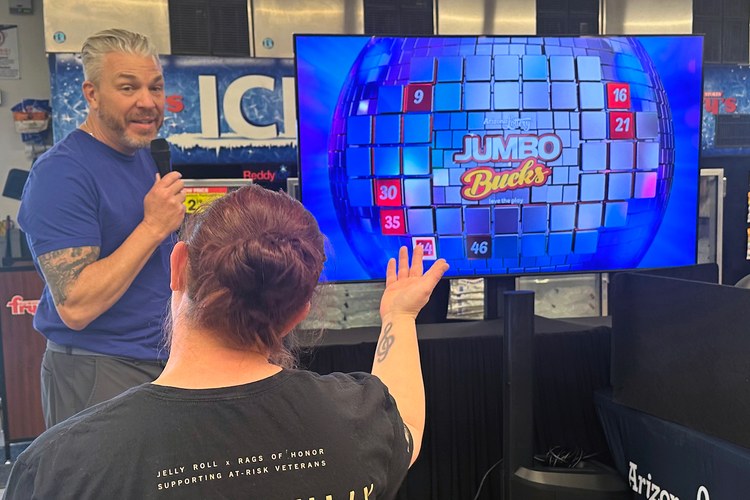
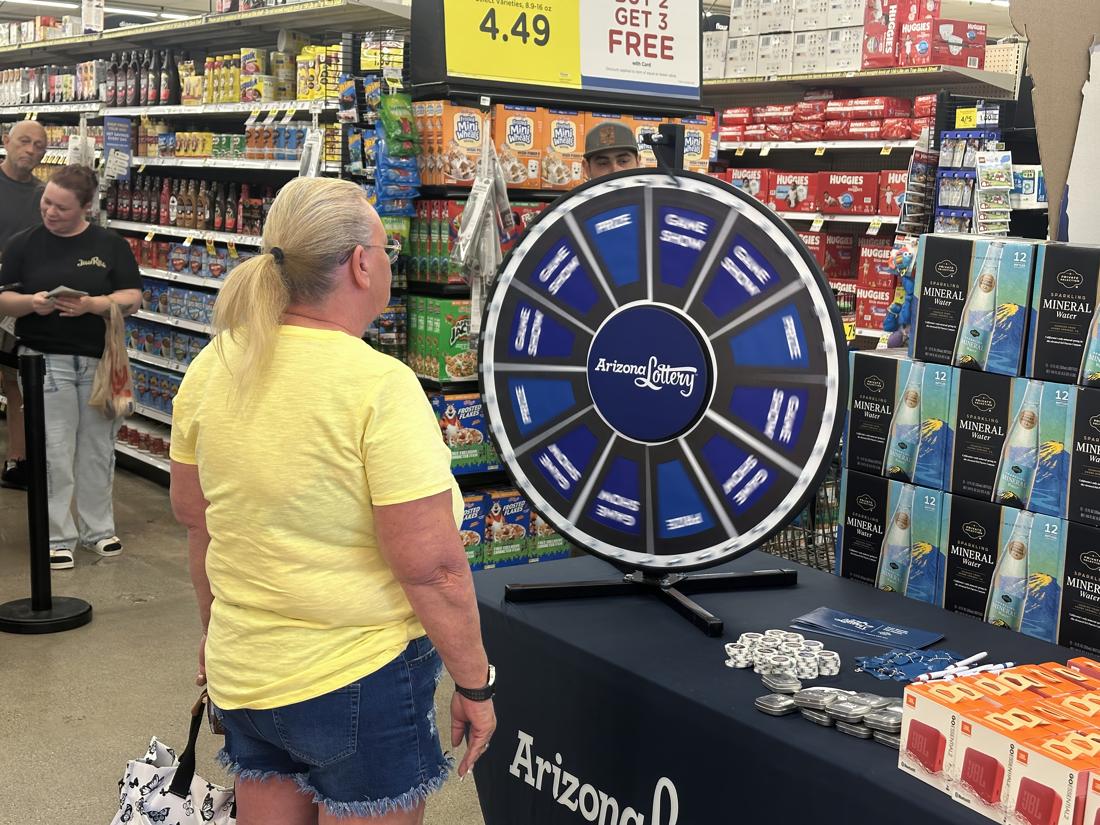
More than 70 people were lined up, craning their necks to see whether they would get a shot at the Jumbo Bucks game show taking place in the store’s self-checkout aisle. Only an hour earlier, that same aisle had looked completely ordinary. Then the Atlas Experiences team moved in. The self-checkout area gave way to a giant prize wheel near the front of the store. Behind it, a custom-built monitor, more than 65 inches across, rose out of a portable road case. Derek Gwaltney, founder and CEO of Atlas Experiences, stood nearby with a microphone in hand, ready to host.
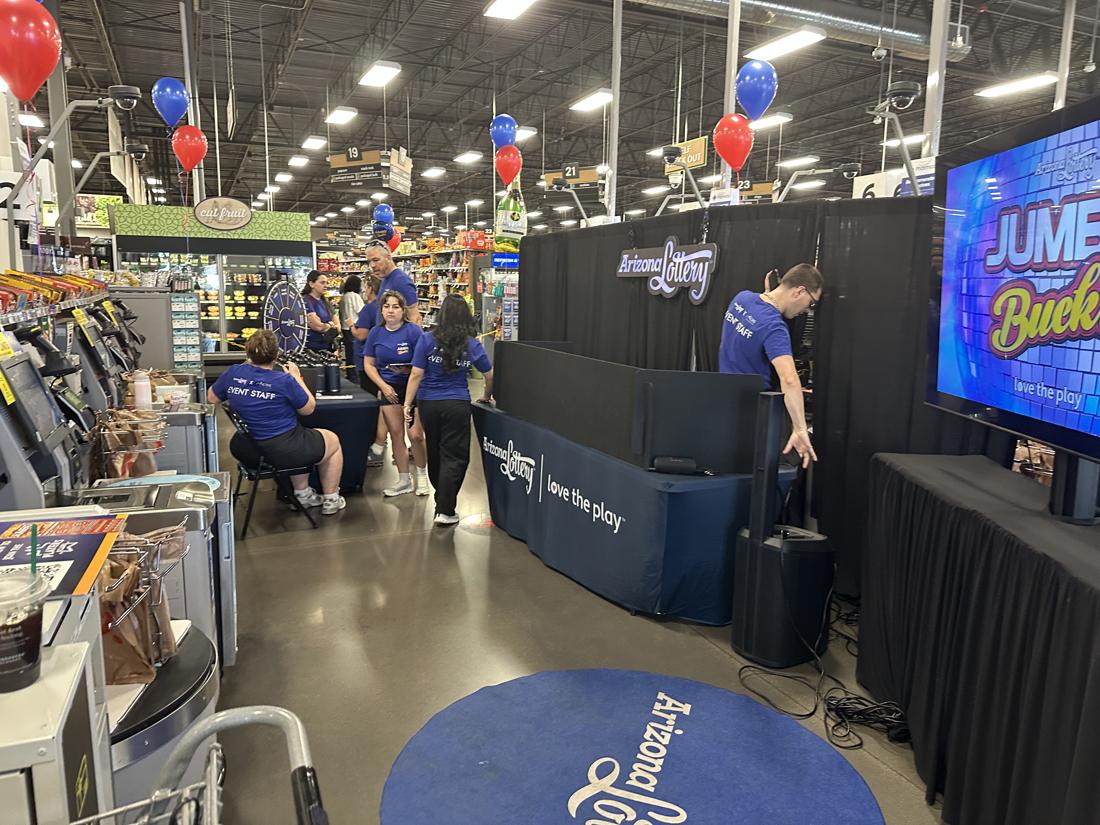
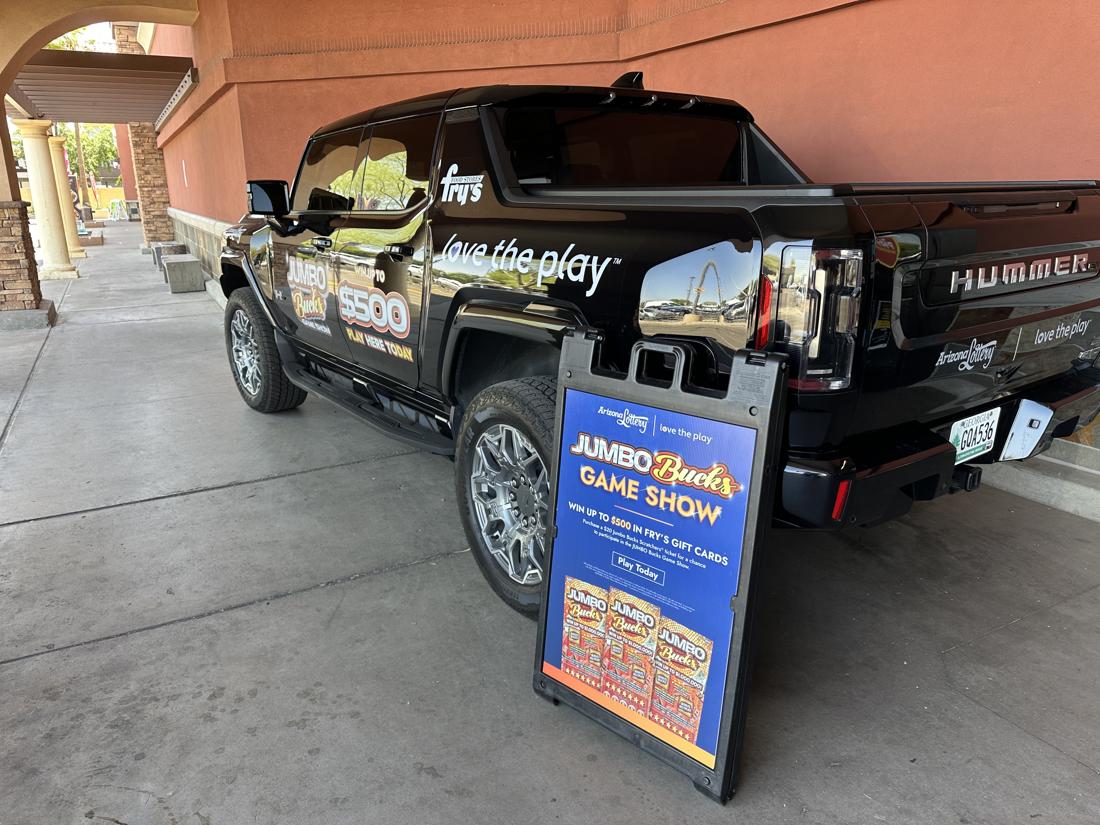
Outside, the store had been remade, too. A branded Hummer sat near the entrance, wrapped for the Arizona Lottery. Inflatable figures waved above the parking lot, attracting shoppers’ attention before they ever reached the automatic doors.
In short, it was a lottery takeover.
“I’ve never seen anything like this,” PJ said. “When they told me that this was going to happen here, I wasn’t expecting this. It is incredible. I would for sure request this in the future. I mean, the addition of sales alone…The customers are loving it.”
At the four activations I witnessed, PJ’s experience was the norm, not the exception. The excitement was infectious. Customers murmured to one another, trying to figure out what the commotion was before slipping into line themselves. Players who had seen the lottery’s social media called family and friends to come meet them. Even store associates asked if they could get in line during their breaks. And managers watched like PJ did; one stayed hours after her shift had ended just to see how the event played out.
It was built around a single ticket launch, the $20 Jumbo Bucks scratcher, and a retailer activation compelling enough to excite customers, store teams, and even Kroger’s corporate office.
Second Iteration
It was the next iteration of this type of event for Arizona Lottery and Atlas Experiences. The first had taken place the previous August, built around an experiential event called $1 Million Mega Market Giveaway. Even in the worst of the Arizona heat, which reached 118 degrees, players still made their way out to see what a $10,000 Grocery Game Show looked like. “The first one we did in the summer, we had a turnout that we weren’t expecting because of the heat, which was always exciting,” said Tiffany Paris, Arizona Lottery’s retail marketing manager. “Then the next thing we know Kroger is all in. Like they wanted to do it again.” Before long, Gwaltney and the Atlas Experiences team were asked to bring the concept back. This time, there would not be an experiential second-chance giveaway. They were activating the new $20 game across 10 Fry’s locations in five days in April.
It is easy to see why Kroger would want more activations like this. The traffic alone speaks for itself. It is just as obvious why the lottery would be interested. Any shopper walking by can quickly deduce that something exciting related to the lottery is happening.
To participate, customers purchased a Jumbo Bucks ticket from the lottery vending machine. An Atlas employee was there to help guide customers through the purchase. From there, players waited in line while Atlas captured their information and asked them a few questions. When it was their turn, they moved to the lucky wheel. One-third of the time, players came out of this round with an immediate prize, anything from a branded Yeti tumbler to a portable JBL speaker. They were great prizes. But they were technically consolation prizes, because what every player wanted was a chance to play the game show.
When a player got a chance to play the game show, Gwaltney took over. Microphone in hand, he had a brief exchange with each contestant, letting the anticipation rise before asking them to pick a number. Behind him was a screen with 50 numbers on it. (Once a number was chosen, it came off the board, meaning no one else could choose it, which created its own sense of drama.) Alongside it were 15-foot-tall dancing inflatables, attracting shoppers’ attention before they even stepped out of their cars.
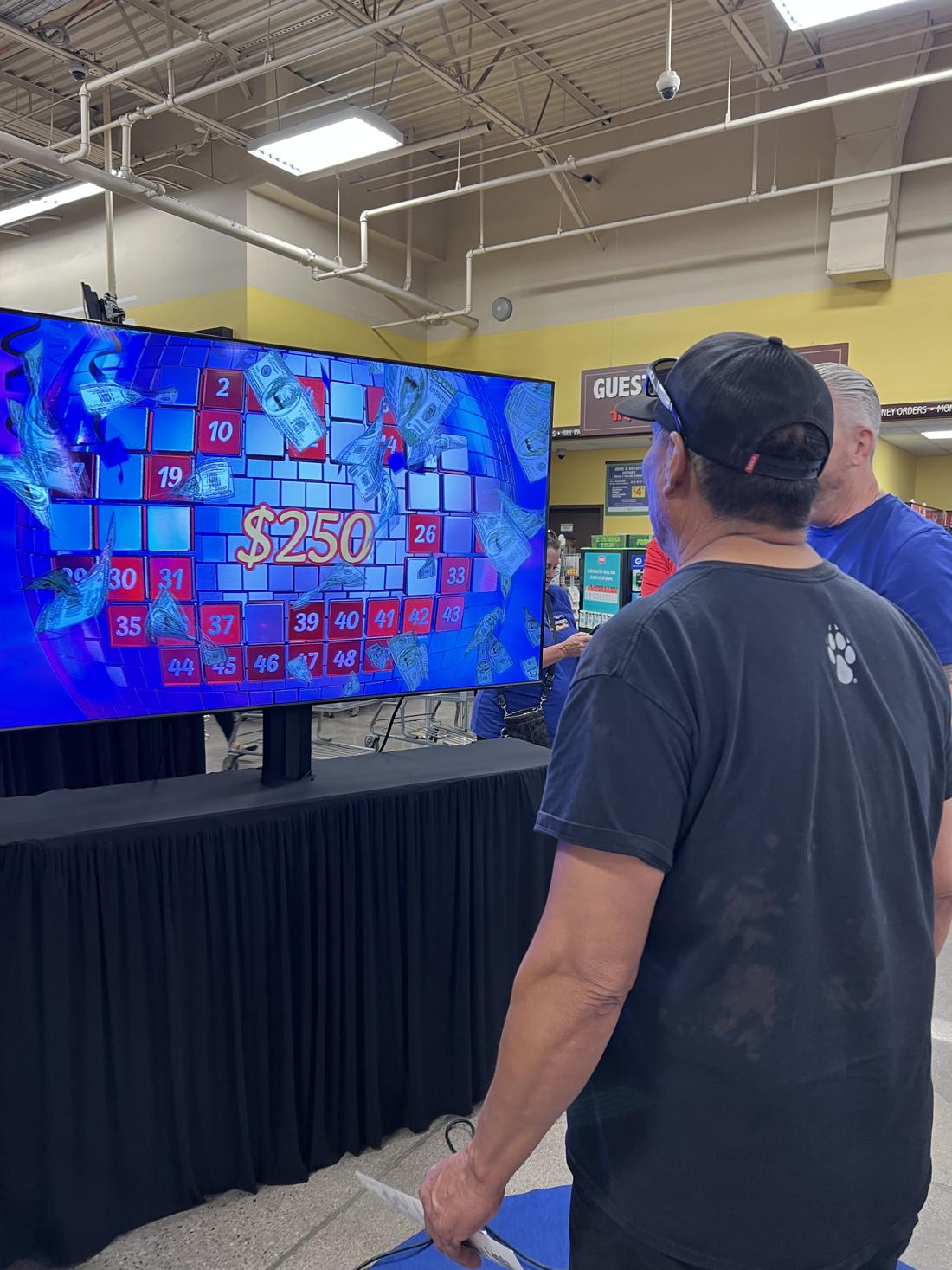
All the events went flawlessly. “The level of execution that goes into a game show of this magnitude is incredible,” Paris said. “Every piece, every experience, everything is thought through.”
The Gift That Keeps on Giving
One thing I had not expected was how social the event became. I would have assumed many people would grab their prize and leave as fast as they could. But some of the first people to win their prize were the last to leave the store. Some cheered on their family members and friends who joined after them. Some just cheered on anyone who got a chance to play the game. In an afternoon, a community of lottery players naturally sprang up. What’s more, they were brand ambassadors, encouraging others in the store to try it or helping them determine if they won on their scratch ticket.
“I can’t tell you how many people … had no idea what to do with the ticket,” Paris said. “I think one of the most important things is getting people to try something that they’re unfamiliar with.”
Given the ubiquity of the lottery, it can be easy to forget that someone might get confused by a simple number-match ticket. But I saw countless people get disrupted on their path to purchase. Some didn’t know how to use the machines, where to scratch, or how to know if they won. At this retail activation, people were guided every step along the way.
The same teachable moment extended to Players Club. Paris said people in line scanned QR codes, asked what the club did, and learned how to enter the game’s second chance promotion. One woman had thrown away a nonwinning ticket when Paris picked it up and explained the second-chance option. The woman told her she had a stack of tickets sitting in her car that she had been ready to throw away.
“She was so excited,” Paris laughed.
For Tonya Beenders, Arizona Lottery’s Chief Sales Officer, the focus was on something more lasting than a busy afternoon: what the event could mean for the Lottery’s relationship with Kroger. When Beenders arrived, she was joined by Peggy Epler, who oversees the lottery category on behalf of Kroger.
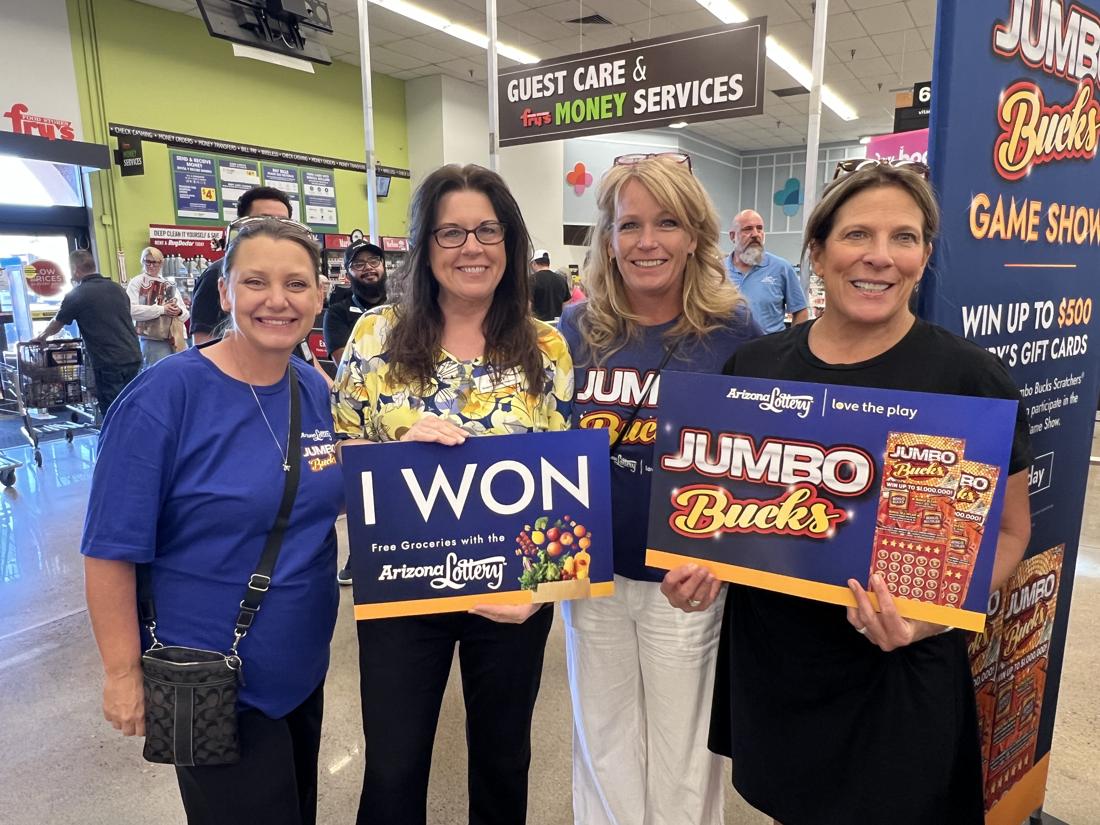
Epler was thrilled about the event. She said: “The Arizona Lottery Jumbo Bucks Game Shows drove exceptional excitement across 10 Fry’s locations, engaging hundreds of customers and bringing energy well beyond typical retail experiences. We’re proud of our Fry’s associates, the support of the Fry’s Division, and especially grateful to the Arizona Lottery for selecting Fry’s for these high-impact events, along with the Atlas team for delivering a first-class execution.”
Positive recognition like this matters for Beenders. Like any fast-moving consumer goods (FMCG) product, lottery depends on the same basics as every other category: location, visibility, and availability. When store managers like PJ and corporate category managers both take notice, it strengthens the lottery’s standing inside Kroger, which Beenders believes could pay serious dividends.
This gives the corporate executives who oversee lottery a stronger case to push for more attention to be given to the category. That could mean helping Arizona Lottery get a second vending placement (or even a third) at key stores. It could move lottery closer to prime store locations, instead of being “shoved over by the bathroom.” Or it could mean more allocated staff hours to reduce out-of-stocks.
“The Kroger team can take this promotion back to the entire corporation and say, here’s why we need more hours devoted to our category,” Beenders said.
The event’s value also showed up in the relationships it created inside the store. “A lot of times the sales reps, the boots on the ground, they have a contact at the courtesy counters. That’s who their primary contact is. But as a result of these, now we were establishing relationships with store directors too,” she said. “It really is the gift that keeps on giving.”
Trinity “Tree” Trammell, one of the Lottery’s boots on the ground, saw the same thing. The activation had become a focal point for the store. “The store’s management team is super excited about it,” Trammell said. “It’s creating excitement in their store. It works for the players, but it’s also bringing in people who maybe already shop here and giving them an extra reason to make another trip to the store, to get extra things, or just to be here to participate.”
Paris, who jokingly informed me that she started one day before Tree and never lets him forget, agreed. “It is a huge relationship builder…We’re bringing value to that. We’re bringing people to them. We’re bringing an experience to them. And that relationship allows us to then ask for things in a way that’s more received.”
For Tree, the event worked because it gave people a reason to make an extra trip or to stay a little longer once they were already there. Some customers came in for the game show and bought other items while they waited. Others discovered it in the store and lingered.
Tree identified one more benefit that had not come up in my other conversations: the event gave the Arizona Lottery team a different kind of day in the field. “It gives us a chance as lottery reps,” Trammell said. “There’s six of us here today. We actually get a chance to meet our team members and have conversations that we don’t normally get. We’re always out in the field. So it’s more of a team-building [opportunity] as well for us on our end.”
A Proven Theory
The Arizona supermarket events showed what Gwaltney has been demonstrating for years: Atlas’s exclusive game-show promotion can work at retail, driving sales while building local awareness. “It’s really the core of the game show: the prizes, the merchandise, the giveaways, the experience,” he said. “How can we get that excitement out into the field? All of it is about creating outreach.”
Lottery might be everywhere, but plenty of people still do not know the basics. Paris and I saw it firsthand. At these events, people were taught by their friends, families, and neighbors. It wasn’t a formal lesson or a set of instructions printed on the back of a ticket. It looked like lottery regulars leaning over tickets in line, showing a newcomer where to scratch and how to check the result, then turning back to the screen to cheer when someone else won.
In short, it took a solitary game and turned it into a social one, at least for an afternoon.
Yet while the event is short-term, the long-term benefits are tangible. Fry’s store managers now know this is something that is on the table. They saw the benefits. They saw the lines. They saw the significant increase in sales.
Kroger has taken notice. More attention could be given to the lottery now, especially if other states follow Arizona’s lead. That is what Gwaltney is after, too. He is not thinking only about one Arizona ticket launch. He wants to take the format “to more lotteries, to more retailers, to more diverse retail.” For him, the challenge is making a lottery promotion easier to run, useful to the retailer, and obvious to the player.
“That’s the challenge I want, because that’s a great problem to have as a business,” Gwaltney said. “And it’s a great challenge to be able to solve for lotteries.”