

Recent Job Listings

When this magazine last wrote about Kalshi and prediction markets, in June 2025, I began it with discussing a $50 “contract” I placed on Carlos Alcaraz to win the French Open. Alcaraz won in spectacular fashion. My win was less spectacular: $48. A more Alcaraz-esque bet would have been investing in Kalshi itself. Had I, my $50 would be worth $1,000. That June, Kalshi had just closed a Series C investment round at a $2 billion valuation. In September 2026, Bloomberg reported Kalshi was finalizing another round. This time at $40 billion.
Too Like the Lightning
The company’s explosive growth in 15 months is remarkable. When Kalshi listed its first sports contracts in January 2025, legal sports betting was already available in nearly 40 states and Americans had wagered a record $149.9 billion the year before. FanDuel and DraftKings kept roughly 74% of gross revenue across 33 reporting markets. Their grip on the market looked unassailable, protected in part by the same significant regulatory barriers that constrained them.

Kalshi broke through by stepping around those fetters. Instead of asking for permission on a state-by-state basis, they registered with the Commodity Futures Trading Commission (CFTC) as a designated contract market. It is the same designation the 128-year-old Chicago Mercantile Exchange (CME) carries for its futures on commodities and interest rates. Federal law gives the CFTC exclusive jurisdiction over swaps and futures traded on federally designated exchanges. Because of that, Kalshi’s position has been that, under the Constitution’s Supremacy Clause, the federal statute governing its contracts overrides any state gambling law that conflicts with it.
That position has been tested early and often. When Kalshi first tried to list contracts on which party would control Congress, the CFTC itself blocked them in 2023. Kalshi sued. In 2024, Judge Jia Cobb sided with the company, stating: “Kalshi’s contracts do not involve unlawful activity or gaming. They involve elections, which are neither.” The agency appealed, but the appeals court declined to halt trading while the case was pending. More than $500 million changed hands on the election.
Then Trump won and, from a federal perspective, everything changed. Donald Trump Jr. joined Kalshi as a strategic adviser in January 2025. Two days after the inauguration Kalshi listed its first sports contracts, the very product its own lawyers had told the appeals court Congress meant to prohibit. Then, in May, under Acting Chair Caroline Pham, the agency dropped its appeal.
The states pushed back but fared poorly. Nevada and New Jersey ordered Kalshi to stop, but federal judges blocked both from enforcing those orders within three weeks of each other.
Kalshi’s success meant it didn’t take long for other companies to follow in their footsteps. Polymarket paid $112 million in July 2025 for QCEX, a CFTC-designated contract market. DraftKings bought Railbird Exchange and its exchange subsidiary for about $47 million at closing in October 2025 and start selling in December. Same as FanDuel, which just started listing its contracts on the CME. Even with states like Maryland threatening to pull licenses in their own jurisdictions, it was too tempting a strategy to ignore. While almost 80% of states have legalized sports betting, a third of the country still doesn’t have access to it. California, Texas and Georgia, along with eight other states have no legal sports betting at all. That’s 110 million people.
Despite this, Kalshi’s first-mover advantage has kept it well in the lead over other prediction market offers. For the month of September, Aldrin Research put Kalshi’s share of sports and parlay contracts at 73.4%, Polymarket’s two exchanges at 16.5% and DraftKings’ at 2.7%. Across every category of contract, Kalshi’s share was closer to 80%.
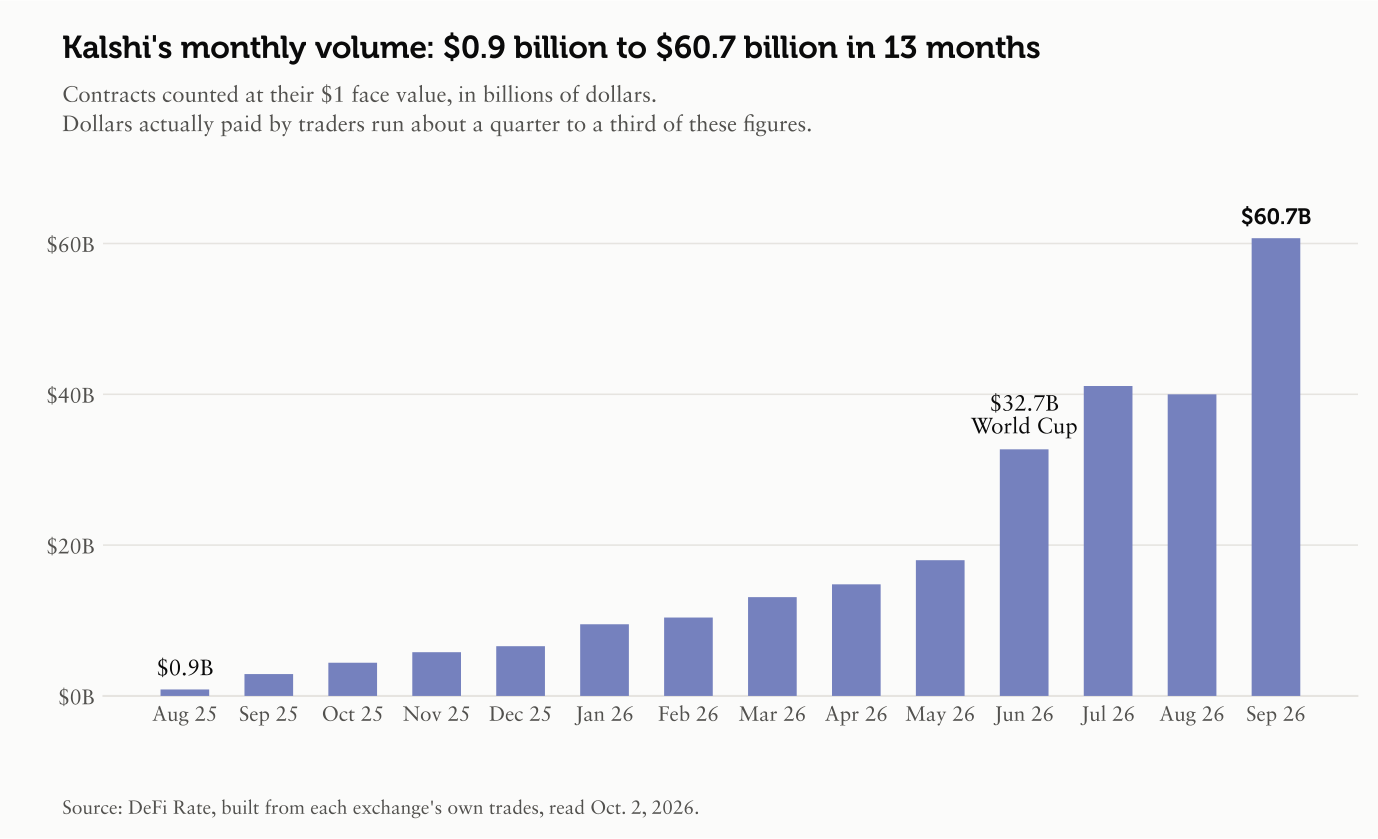
The market is also expanding. Kalshi’s volume went from $24 billion in all of 2025 to about $240 billion in the first nine months of 2026, with $60.7 billion in September alone and a record $3.2 billion on a single NFL Sunday.
A Bet By Any Other Name
As a group, lotteries took a public stance in May 2026. The World Lottery Association published an 18-page position paper: “Prediction Markets: Unlicensed Betting by Another Name.” Its test is one sentence long: “any product that offers a financial return contingent on a sporting or event outcome is a bet, and must be regulated accordingly, whatever label the operator chooses to attach to it.” And to the platforms’ answer that they are already regulated, it replies that “authorization under a financial or derivatives framework is not equivalent to a gambling license.”
The paper raises four concerns about prediction markets operating outside local gambling regulation. 1.) Unlicensed operation: platforms offering “sport-event and lottery-based contracts” without a local license, outside the Macolin Convention that governs sports integrity. 2.) Match-fixing: no monitoring, no suspicious-transaction reporting and no insider-trading rules, which the paper calls “a direct route for corrupt actors to monetise manipulated outcomes.” 3.) Player protection: no age verification, self-exclusion, spending limits or problem-gambling support. 4.) Unlevel competition: licensed operators “bear the full cost of compliance, taxation, and public good contributions,” while the platforms bear none of them and compete for the same customers.
The WLA points to research that shows lotteries and the good causes they support will be hurt. “In the US, prediction markets have achieved 81% awareness among 18, 20-year-olds and 49% brand recognition for Kalshi among 25, 34 year-olds, the precise demographic cohorts the lottery industry depends on to renew its player base…. In a recent US study, Lotto Research found that 32% of players who intend to use prediction markets explicitly state they will reduce their lottery spend.”
It even makes the point that a a lottery drawing is an objectively verifiable, time-bound event. It is a natural fit for a contract based argument. It is a direct threat to the industry. If lottery-style contracts took 5% of the sector’s revenue, good causes would lose more than $2 billion a year.
What’s in a Name?
The WLA paper echoes one of the states’ core arguments against Kalshi: financial oversight should not exempt betting products from gambling regulation. To see where that argument fits, consider Kalshi’s central reasoning
- Its sports contracts qualify as swaps under the Commodity Exchange Act.
- The Act places swaps traded on its federally designated exchange within the CFTC’s exclusive jurisdiction.
- Therefore, Kalshi argues, states cannot apply their gambling laws to those contracts.
The states challenge two links in that chain. First, they argue that the sports contracts do not meet the statutory definition of swaps. Second, even if the contracts qualify, the states contend that federal supervision of the exchange does not displace their gambling laws. In their view, Kalshi must satisfy both federal exchange requirements and the rules governing sports betting where it operates.
That second argument carried the day in Maryland in August 2025. A federal judge assumed, without deciding, that Kalshi’s sports contracts were swaps, but concluded that the company had not shown it was likely to succeed in proving that federal law displaced Maryland’s gambling laws. He denied Kalshi’s request for a preliminary injunction and pointed to a practical route to compliance: obtain a Maryland sports-wagering license while continuing to meet federal exchange requirements. In his analysis, the two systems could operate together.
To understand the former argument of why sports contracts are not swaps, it is critical to understand the history of these contracts, which goes back 150 years or more. Consider a farmer in 1865 planning his fall harvest. The almanac predicts fine weather, which means a great harvest. The problem is that it also means everyone else may have a great harvest too. Come fall, the mills will have more grain than they can process. Supply and demand kick in. The price of grain collapses and the farmer cannot make a profit. He wants to protect himself, so months before the harvest he goes to the miller and offers to sell his grain at a fixed price. The contract is protection. The farmer swapped his risk for certainty.
When the states say a football game is not an event “associated with a potential financial, economic, or commercial consequence,” this is what they mean. The farmer’s exposure to grain prices exists before he signs the contract. Sports results can also affect businesses, players and sponsors, but the states argue that those downstream effects do not establish the inherent financial connection the statute requires.
Kalshi’s response is that its markets provide information and are still protected, harkening back to Supreme Court case regarding regulated derivatives. By the turn of the 20th century, the contracts between farmers and millers had become big business. Private companies, like The Chicago Board of Trade (which would eventually become part of CME Group), allowed registered members to buy and sell bushels of grain, many of whom would never lay hands on one. Others wanted in. “Bucket shops” would steal the Board’s prices off the ticker, then would let layman buy and sell, just like the private members of the Board. The Board sued one of them, Christie Grain, for pirating its quotations. The shop answered that the Board was conducting illegal gambling shop, allowing members to gambling of the price without ever exchanging real bushels of grain. The fruits of an illegal business, the shop argued, cannot be protected by law.
The Court sided with the Board. A set-off allowed matching obligations to buy and sell grain to be settled by paying any price difference in cash, without physically delivering the grain. A set-off, Justice Holmes wrote, “is in legal effect a delivery.” He also defended the economic value of speculation: “Of course, in a modern market contracts are not confined to sales for immediate delivery… Speculation of this kind by competent men is the self-adjustment of society to the probable. Its value is well known as a means of avoiding or mitigating catastrophes, equalizing prices and providing for periods of want.”
Holmes rejected the argument that settling trades without physically delivering grain made the Board an illegal gambling house. The contracts imposed real obligations, and the market served real economic purposes. Its prices conveyed information: expectations of a thin harvest could push prices higher, encouraging farmers to plant more and buyers to prepare for shortages. The Court also supplied a separate reason to protect the quotations: the Board’s confidential information remained its property even if some underlying trading was unlawful.
Kalshi argues that its markets likewise produce useful information. The states question whether that information performs the economic work contemplated by the Commodity Exchange Act. Predicting a game’s result, they argue, does not give a sports contract the same connection to financial risk as a contract tied to grain prices or interest rates. Holmes helps explain the historical distinction between useful speculation and wagering. The modern courts must determine how the statute applies to these contracts.
Rubber Meets the Road
Both sides have won in appellate court. In April, the Third Circuit upheld Kalshi’s preliminary injunction against New Jersey, two to one. The majority read the swap definition broadly: an event need only be associated with a potential economic consequence. A game’s outcome can affect “sponsors, advertisers, television networks,” so the contracts qualified. The court also rejected New Jersey’s attempt to enforce its gambling laws against those trades. Congress had placed exchange-traded swaps under the CFTC’s exclusive jurisdiction, the majority reasoned; allowing states to prohibit them would restore the patchwork of regulation the federal system was designed to replace. Calling the activity gambling did not, in the majority’s view, give New Jersey authority to prohibit those contracts.
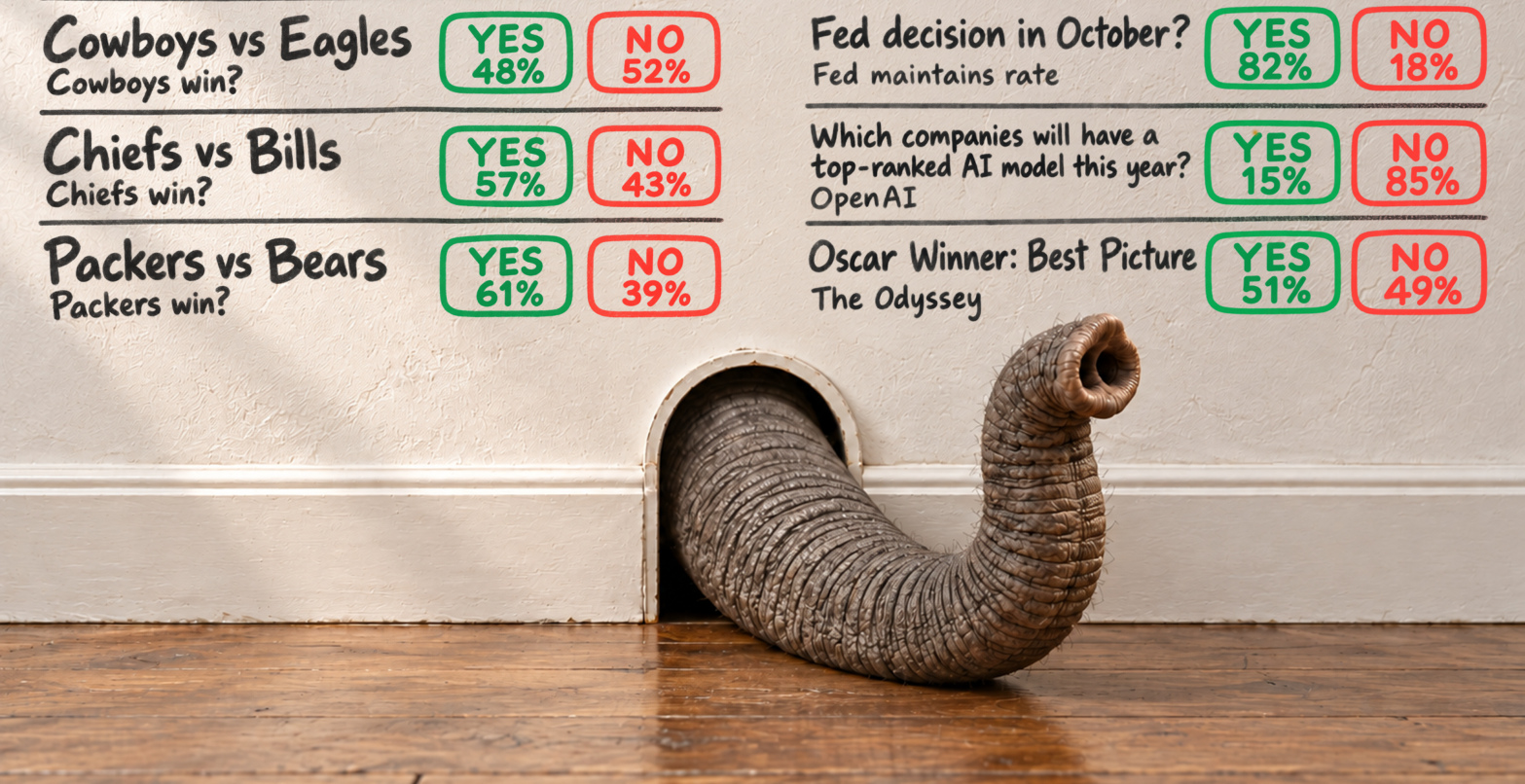
To conclude otherwise would assume Congress was ‘hiding an elephant in a mousehole,’ something we decline to do.
U.S. Court of Appeals for the Ninth Circuit, KalshiEX, LLC v. Assad, August 28, 2026
In August, the Ninth Circuit, in Nevada’s case found the contracts “do not help institutions or investors hedge against risk; they create risk, largely for ordinary consumers, where none previously existed.” It added that “the CFTC is not a national gambling regulator,” and that reading a 2010 Wall Street reform bill to legalize sports betting in every state would assume Congress had hidden “an elephant in a mousehole.” The vote was three to nothing.
The Sixth Circuit went further. Even if Kalshi’s sports contracts qualified as swaps, the court held, federal oversight would not exempt the company from Ohio’s and Tennessee’s gambling laws. The CFTC could regulate the exchange while the states enforced their rules for sports betting. Kalshi would have to satisfy both sets of requirements. The vote was also three to nothing.
Wisely and Slow
The Fourth Circuit, which heard Kalshi’s appeal in May, could rule any day, and the trajectory favors the states. The CFTC, which has gone from Kalshi’s adversary to its co-plaintiff, has tried to get around the courts by rulemaking: in September it sent the White House, for review, a proposed rule that would define event contracts as swaps outright. But a rule cannot overrule a court’s reading of a statute. So whatever the White House or the Fourth Circuit does, now that the Sixth and Ninth Circuits have split from the Third, the question seems destined for the Supreme Court.
It will not likely rule soon. Truist’s Barry Jonas told clients after the Ninth Circuit’s decision that a resolution is ten to twenty-two months away, and Kalshi, by asking the Ninth Circuit to rehear its case, has already added to the clock. But prediction markets should be nervous. In February’s tariff decision, Chief Justice Roberts, joined on this point by Justices Gorsuch and Barrett, demanded clear congressional authorization for the sweeping power the president claimed. The states can argue that nationwide sports betting raises a comparable question.
If Kalshi ever posts a contract on the outcome of its own case, the states’ odds look better than ever.