


The self-service market is already sizeable, accounting for more than $31 billion in the U.S. alone. However, new use cases and innovations are projected to propel self-service to $129 billion globally by 2030.
According to a recent survey of 1,000 Americans conducted by PlayUSA, 84% of respondents reported a preference for self-service, and 66% indicated a preference for self-service over clerk checkout (1). For the next generation of lottery players, a robust self-service program is mandatory.
Players expect self-service options that support all their preferred play styles, provide functionality they expect, such as mobile payments, and are accessible and consistent across all retailer locations and store formats.
It’s been widely discussed that the retail environment and how retailers operate and interact with consumers have evolved profoundly in the past five or six years.
“Player expectations are higher than ever, retailers are more critical than ever, and it’s time to evaluate our expectations of the lottery retail experience,” says Joe Fulton, VP of Product for Scientific Games. “Purchase formats like self-service and self-checkout, non-cash and mobile payment options, and consistency across digital and retail experiences are now leading drivers of lottery purchase decisions.”
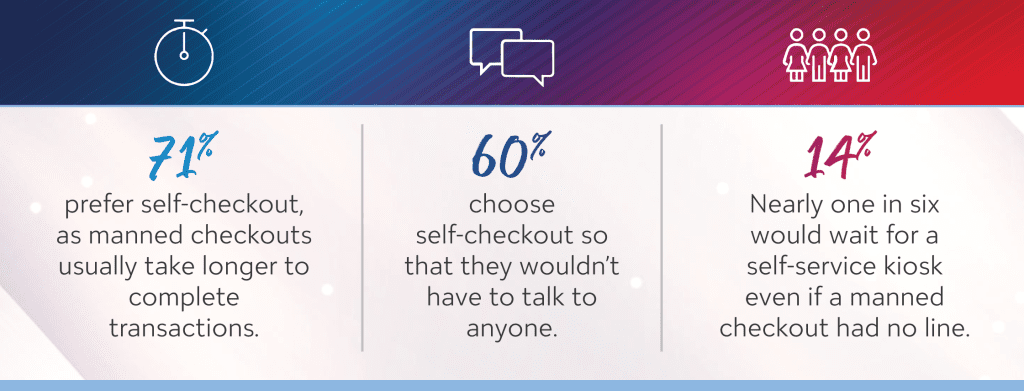
According to PlayUSA, 60% of consumers chose self-checkout so they didn’t have to talk to anyone, and nearly one in six (14%) said they would wait for a self-service kiosk even if a clerk-manned checkout had no line. PlayUSA research also indicates that 71% of respondents prefer self-checkout because manned checkouts typically take longer to complete the transaction.
Self-Service and Lottery–A Growing Trend
The U.S. lottery market appears to be listening—from 2018 to 2023, the number of self-service lottery terminals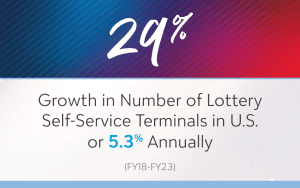 increased by 29% in the U.S., or roughly 5.3% annually (2).
What’s happening at retail goes beyond addressing a growing consumer need or preference. There is also evidence that implementing self-service technology can increase sales.
An analysis of two states where Scientific Games installed its PlayCentral self-service vending technology illustrates this (3). In each state, PlayCentral vending technology was installed in a subset of the lottery’s retailer network. Some retailers offered self-service, while others did not.
Lottery A’s retailers with self-service terminals saw a 4.2% increase in year-over-year lottery sales, representing a net growth of almost 9%. Similar results were observed with Lottery B—retailers that provided a self-service solution experienced a 9.2% increase in lottery sales, resulting in a net growth of almost 17%.

Scientific Games’ PlayCentral family of self-service lottery terminals is a highly regarded and well-established part of the lottery landscape, with tens of thousands of units deployed in lottery markets across the U.S. The family of full-service player-facing terminals has been redesigned in several different footprints to integrate seamlessly into any retail setting—each offering a full array of lottery products, including instant scratch, draw, high-frequency draw and fast play games. Cashless payment options for both pay-in and pay-out are a critical part of Scientific Games’ full retail solutions portfolio.
“We’re excited to be responding to both retailer and player opportunities by designing unified digital content experiences into our self-service family,” Fulton shares.
All PlayCentral terminals offer a smartly displayed, intuitive experience and data-driven game recommendations. They simplify retailers’ operations by integrating business intelligence and streamlining reporting.
SCiQ Takes Lottery Self-Service to a New Level
Thanks to Scientific Games’ groundbreaking SCiQ technology, PlayCentral terminals offer even greater functionality, giving lotteries and their retailers unprecedented store-level instant game analytics and inventory control.
Powered by SCiQ, Scientific Games’ PlayCentral self-service terminals can now actively scan the barcode of every instant game ticket dispensed, providing real-time unit visibility to both lotteries and their retailers. The powerful new advantages include:

PlayCentral Powered by SCiQ also provides a number of enhanced reporting and accounting benefits. Every ticket is tracked in real time, allowing for easy accounting of every sale with the push of a single button. What used to be a manual process taking up to 30 minutes a day can now be completed in seconds and can be generated by shift, day, week, and even by clerk.
Lotteries and their retailers can now receive automated notifications for any anomalies or variations that might occur. These notifications can be configured to target specific audiences, allowing them to receive only relevant notifications.
With SCiQ, retail chains have a common platform to track sales, manage inventory, and push out communications. Chains no longer have to accommodate individual lottery jurisdictions with different reporting structures.
PlayCentral Powered by SCiQ offers advantages beyond those associated with real-time, unit-level inventory data, including expanded instant game ticket bin capacity within the same footprint. Retailers benefit from more facings, more product variety, and the ability to drive more sales with self-service, all without any additional floor space required.
 The SCiQ system also offers retailers streamlined pack activation. Instant games are sold in fast-paced, service-driven retail environments where seconds count. Eliminating the need to scan packs at the retail terminal saves valuable time.
If supported by the gaming system, ticket packs can be activated automatically when loaded into the PlayCentral bin, eliminating the need to scan the pack at the retail terminal before loading.
“When PlayCentral Powered by SCiQ is paired with Scientific Games’ other retail solutions, lotteries and their retailers gain a truly comprehensive picture of their lottery operation at a granular level,” Fulton explains. “Every ticket for every game in the entire ecosystem is individually accounted for: tickets at the counter, tickets in self-service vending machines and tickets in the store safe. This enables lotteries and retailers to manage their business in a way that optimizes sales, time and generates maximum revenues.”
“Non-cash payments and self-service terminals can be tailored to every unique retail environment. But Scientific Games is innovating beyond the horizon. Once a simple convenience, overwhelming data suggests self-service is here to stay. Retailers are more excited than ever about options for lottery self-checkout in grocery, big box and convenience stores,” he says.
Whether at clerk, self-checkout or self-service machines, retailers need a lottery experience fully integrated into the player’s in-store interaction. The opportunity for loyalty integrations and consumer product good partnerships with touchpoints at lottery self-service and mobile endpoints is growing.
“The power of connecting lottery player engagement with retailer and CPG loyalty in store environments utilizing self-service, digital menu boards and integrated transaction displays is transformative for lottery,” Fulton shares.
Sources
- https://www.playusa.com/americans-and-technology/
- La Fleur’s Almanac, 2024 and The Ohio Lottery, 2024
- Scientific Games, LLC © 2025
- Scientific Games Sales Data: PA CY10-CY23; MD CY17-CY23; DE CY18-CY23
PlayCentral®, PlayCentral® Powered by SCiQ® and SCiQ® are registered trademarks of Scientific Games. © Scientific Games, LLC. All rights reserved.